PROUT

PROUT
For a More Progressively Evolving Society
Showing posts with label progressive alternative. Show all posts

Thursday, September 8, 2016

A Brief Introduction to PROUT, Progressive Utilization

During the 20th Century, Marxism and capitalism were the contending economic theories and the world was almost engulfed by a Third World War due to the struggles between them.   

Yet, the collapse of the Soviet Union and the other communist bloc governments laid the way for the triumph of capitalism.  Today, however, half of the world’s population lives on two dollars a day or less, and the developed countries are in an economic recession reminiscent of the Great Depression of the 1930s.  Once again, people are asking, “Is there an alternative to capitalism?”

In 1959, Prabhat Ranjan Sarkar, an Indian philosopher and historian, answered this question when he presented the Progressive Utilization Theory (known by the acronym, PROUT).  PROUT is an economic theory addressing the defects of both capitalism and Marxism, offering the promise of a new economic order in which the world’s resources are distributed in an equitable and rational manner, anchored in homeostasis of society en whole.
Explore more Praise for PROUT http://bit.ly/PraiseForPROUT

We can understand PROUT by looking at six essential features of this new progressively designed socio-economic system:

1. Spirituality:  Both capitalism and Marxism are materialist philosophies with a worldview that gives little (in the case of capitalism) or no importance to spirituality.  PROUT, on the other hand, is founded on a spiritual outlook -- of the Universe as a singularity and all life as a diversity of its experiential expression.  According to Sarkar, the material world is but an expression of consciousness and humans are stewards rather than ultimate owners of any physical wealth.  The goal of society is to provide a base from which humans can expand their full mental, physical and spiritual possibilities.  This spiritual basis of PROUT has important implications for the management of physical resources, for the development of human resources and for the establishment of proper governance.

Adopting such an inclusive worldview envisioned by Sarkar, our relationship with the environment will change.  Similarly, when we regard other beings as manifestations of that one Consciousness, our relationships with each other will change. When such a transpersonal worldview permeates our whole society, we will derive the kind of service-minded and selfless government that is currently lacking in the world today.

2. A “Floor and a Ceiling”:  Welfare economists have always emphasized that the minimum necessities of life should be provided for everyone in a properly structured society.  Efforts to make a minimum wage or to provide various kinds of welfare systems to help impoverished people are all part of such concerns.

P R Sarkar agreed with some aspects of welfare economics, stating that the minimum necessities of life should be guaranteed to all members of society.  However, he recognised that if society would just give people a check at the end of the month, with their required income, then this would only encourage laziness.  According to Sarkar, the best arrangement is that society should provide people with the purchasing power to procure the minimum necessities of life in exchange for their labor.  Full employment providing everyone with the proper amount of purchasing power thus provides the “floor” of the economic system.  No one should be allowed to “live in the basement”.

Where PROUT breaks new ground is in its attention to the “ceiling” of the economic system.  The poverty of many is tied to the affluence and over-accumulation of a few, and if we really want to bring about a harmonious society we need to think about putting limits on the amount of physical wealth a person can accumulate.  

In the first principle of PROUT, it is stated that “no individual should be allowed to accumulate any physical wealth without the clear permission and approval of the collective body of society”.
The splattering of Reaganomics "for the people"

This concept is sure to evoke howls of protest from the super-rich, the very rich and even middle class people aspiring to wealth.  The classic argument of wealthy people is that by their effort, wealth is created and this wealth will trickle down to the rest of society. Apologists of laissez faire capitalism have been very successful in convincing people that this is the truth, but the starving, sick and homeless people of the world have been waiting for a long time for the wealth to trickle down, and it does not seem to be happening.

Sooner or later, we will come to our senses and realize that the over-accumulation of wealth in the hands of a few is not in the best of interest of society as a whole and this principle of PROUT, curbing excessive accumulation, will surely be put into practice around the world.

3. Economic Democracy:  In the past century, a great deal was said about making the “world safe for democracy”.  But, the “democracy” that was talked about was political democracy.  In many of the impoverished countries of the world, the same ones where people struggle with $2.00 per day, the people have the right to vote but they do not have any say in their economic life.  Similarly, even in developed countries a person can vote to decide who will be the next president, but he or she usually has no vote in deciding economic matters that are very close to home, such as keeping a job.

According to PROUT theory, society should be organised in a manner that will empower as many people as possible.  One of the best ways to do this is reorganize the ownership and operation of economic enterprises.  Under capitalism, the primary business form is the corporation.  The owners of the shares of a corporation have all the votes and decide how the enterprise will be run.  Those who work in the enterprise have little or no say in the vital economic decisions affecting their lives.   

PROUT's system establishes co-operatives as the most meaningful business form.  Most enterprises, except the very large key industries and very small businesses, would be organised as co-operatives, particularly those enterprises engaged in producing basic necessities of life.  Those who work in the enterprise will be the owners and will elect management and will vote in elections governing the running of the enterprise.  

In a PROUTist economy, the very small enterprises with a few employees and dealing in nonessential goods could be privately owned and operated, and the medium enterprises would be owned and operated as co-operatives.  Large-scale key industries (energy, communication, transportation, etc.) would be publicly managed either by local governments or by special public bodies (in unitary political systems).  This three-tiered system of private, cooperative and publicly run enterprises would provide the base for economic democracy.

4. Economic Reorganization (Decentralized Economy, Balanced Economy and Regional Economic Self Sufficiency)

If we want to bring about the economic well being of all of the people, then we must also make sure that some geographic areas are not depressed while other areas are thriving.  The best way to bring about economic development and prosperity for everyone is to decentralize the economy, develop all sectors of the economy and to strive for regional economic self-sufficiency.

One of the biggest reasons for economic imbalance within any particular country is the modern trend of urbanization.  Usually most manufacturing and many other services serving the manufacturing sector are situated in cities.  The metropolitan areas thrive, and people in the countryside are either unemployed or work in low-wage or subsistence agriculture.

The best way to reverse this situation is to place some industries, and supporting services and industries in rural areas.  In this way, excessive congestion of urban areas will be avoided and strong regional centers will provide employment and services to previously neglected rural areas.

Economic decentralization should also be coupled with balancing the various sectors of the economy:  industry, agriculture and services.  In some countries, more than 75% of the people work in agriculture and a small minority in industry and services.  Underdeveloped countries with poor economies are usually structured in this way.  In industrialized countries a huge majority of the population work in industry or in services, and very few people are engaged in agriculture.

Sarkar said that a more ideal set-up would have approximately 20% of the population in agriculture, 20% in agro industries (producing goods using agricultural produce), 20% in agrico-industries (supplying machinery and tools for agriculture) and the rest of population in industry and services.

A society with this kind of economic balance would be better able to achieve economic self-sufficiency.  Currently “globalization” is the buzz-word of the era, and economic self-sufficiency is not in vogue.  But, is it really healthy for any country to neglect its agricultural sector and rely on imported food?  Similarly, should some countries remain with little or no industry and rely on far-away countries for all their finished products?

Generally, countries which depend solely on agriculture or which export raw materials like wood and minerals remain poor while heavily industrialized countries thrive.  This is not good for the non-industrialized areas, but it is also not healthy for the developed countries as well.  In times of war or in time of any disruption to transportation, their vital food supplies will be in danger.  

On top of this, in a world where climate-warming and ecological difficulty have become major problems, does it continue to make sense to rely on centers of supply (for either raw or finished products) that are halfway around the world?  
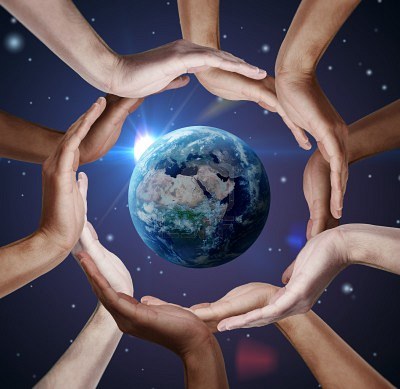
We all lend a hand for the welfare of
community and society

PROUT recommends that countries in a particular geographic region come together and form economic zones that have balanced, decentralized and self-sufficient economies.  Such an arrangement would be ecologically advantageous, provide for economic security in times of war or unforeseen disruptions of transportation, and most importantly would ensure that no particular country or region will remain in poverty while others thrive.

5. Moral Leadership

The various plans for a better organisation of the economy and for economic democracy are good in theory, though the problem of materializing these noble ideas depends on the quality of the human beings of our society.  If elected and appointed, corrupt officials will prevent the implementation of policies designed to bring about social and economic wellbeing for all.  For example, the social equality preached by the Marxists was belied by the reality of corrupt government officials living in luxury while the masses remained in poverty, and all too often, operating as a monopolistic organized crime syndicate of state.

The only way out of present economic and political problems is to elevate the moral standard of our society.  If people are properly educated, conscious of their social and economic responsibilities and morally fortuitous, then democracy can thrive and moral leadership will come to the fore.  The hope of the future will rest on the shoulders of men and women who will enter public office with the spirit of service and sacrifice rather than for the selfish purpose of lining their own, and others' pockets or enhancing their prestige.   
A proper spiritual outlook coupled with an educational system that is free from political interference and focused on the all-around development of human beings is the best way to bring forth leaders who are morally fortuitous and working for the wellbeing of society.

6. Global Governance

Against the backdrop of the universe, the earth is a small planet and human beings find it necessary to learn how to live together in harmony on this small planet.  The best way to minimise the possibilities of war and to safeguard the rights of all people is to establish a global governance based upon universal principles.  Previous attempts in the 20th Century in this direction, namely the League of Nations and the United Nations, have not been adequate and it is time to move onto a better threshold of global coordination.

In his book, Problem of the Day, P R Sarkar laid out a concept of world government that should be achievable in the near future.  He advocated the establishment of a bi-chambered world government.  One chamber, the lower house, would have representation  based on population and the other chamber, the upper house, would provide equal representation for all nations.  The upper house will not be able to pass a law unless it has first been passed by the lower chamber, but the upper house will also have the right to reject bills passed by the lower chamber.

Sarkar envisioned a stage-wise movement towards world government.  In the first phase, the world body would only be able to frame laws and administration would be in the hands of governments of the individual countries, as a confederation.  In a later stage, the world government would also have administrative authority and a world militia at its disposal.  In the past, world government was considered a utopian dream, but in the near future, it will become a necessity.  Today, larger countries with various states or provinces do not experience any of their various states or provinces going to war against each other due to the practical implementation of centricity while accommodating and flourishing the sanctity of each and ever dominion within their borders.  Such a threshold of excellence in government can also occur on global realms in a progressive manner.  


These are the core economic and political ideas that form the backbone of the Progressive Utilization Theory.  In the years ahead, they are sure to be the pillar of efforts to solve the thorniest problems that confront humanity today.  


This article redacted from an original appearance here.


Political Democracy can and will be fortuitous
when Economic Democracy is established.  

Explore this and other articles covering alternative economics, ethical leadership, economic democracy, and a society without the weal and woe of social and economic vicissitudes HERE  
How does PROUT compare or contrast with capitalism or communism?  Explore the answers HERE

What are essential ingredients assuring progressive sustainability bereft of the vicissitudes of economic or political predation, privation or disparity?  Learn more HERE  

Saturday, August 31, 2013

Sadvipras: PROUT’s Paradigm of Enlightened Leaders

Guest article

Explore this and other articles covering alternative economics, ethical leadership, economic democracy, and a society without economic vicissitudes HERE


by Jody Wright, PROUT activist for 35 years.
[Excerpted from a presentation at the First Global PROUT Conference in Venezuela, "Building a Solidarity Economy based on Ethics and Ecology", July 7-9, 2011, Caracas]
I’d like to talk today about the concept of leadership in PROUT. Sometimes I think of leadership as the magnet that makes all the iron filings on a piece of paper face the same direction. Leadership is what helps us to organize ourselves so that we get where we want to go.
I think it’s important to start by looking at mediocre leaders. Where do leaders fail us? Some leaders want power for personal gain and they feel that they’re better when they’re the leader. They feel that they want something for their own selves out of it. They want the recognition, the adulation that comes from it.
Some mediocre leaders aren’t clear about where they’re going. They may take people in one direction, and then in another direction. They don’t have the ability to look at what they’re doing from a bigger perspective. They may lose their direction, and take people to the wrong place.
Some leaders can be bought out by other people, they’re very influenced by other people. If their basic desire in being a leader is to be recognized and to be looked up to by others, it may be easy for them to be bought out by others. Or if their desire is for personal gain, to have more money in their pocket, they can be bought financially.
Some leaders lack skills to organize groups. They are in a leadership position, yet they don’t pull the whole group together. They may not know the balance between structure and direction that’s needed by the group.
Social change and real revolution requires excellent leadership. Not just leadership that is mediocre, that doesn’t know the direction, that gets lost, that’s for personal gain, but truly excellent leadership. So I’d like to spend some time talking about what that excellent leadership looks like.
According to PROUT founder P.R. Sarkar: “Those spiritual revolutionaries who work to achieve progressive changes for human elevation on a well-thought, pre-planned basis, whether in the physical, metaphysical or spiritual sphere, by adhering to the moral principles of Yama and Niyama, are Sadvipras.”

So, let’s look at that together. Some qualities of excellent leaders is that they’re physically fit, their body is in good shape to do the kind of leadership that is necessary, to do whatever is necessary: to carry to handle hard situations – it really helps to be physically fit. They’re mentally developed: they have the capacity to look at things from a number of different perspectives, to take the information that is around them and put it together in ways that makes sense. They have this capacity in an exceptional way. And they’re spiritually elevated. When we understand things from a spiritual perspective, we have a bigger picture of things. We understand things from the point of view of the universe and not just the point of view of our own selves.  


Excellent leaders, sadvipras, as P.R. Sarkar calls them, are well-rounded in their development. They’re not just intellectually very bright and good at looking at facts, but they’re also good at putting those together and making them work into something. They have control of their emotions, and yet they feel very much for the people around them. They are capable of both doing things themselves and of leading others in doing them. They’re able to physically work hard, a lot of leadership requires rolling up your sleeves and doing it, and no amount of telling other people to do it does the job. You need to demonstrate, you need to lead, you need to show that you are part of all the other people and willing to work hard and do the work yourself, too.


It’s important to people be able to protect family and community and knowing the skills of protection, the skills of caring for others. It’s an important part of leadership, because if we don’t care for each other, if we don’t protect each other, we won’t have people to lead. It’s important that all the needs get met.
To be intellectually knowledgeable is an important part of being a good leader. We need to have the knowledge and the understanding. We need to really be able to think as leaders in order to give directions to others that make sense. Things are so complex in our society today that it requires a very settled and active mind.
It helps to be entrepreneurial and organized. Somebody who is entrepreneurial has a lot of new ideas, they can look at things from a new perspective, they can come up with the idea to meet the conditions of the moment. If you are organized, you are able to direct other people, to guide people, and to know when to sit back and listen, and when to step forward and speak. You can look ahead if you’re organized and see what the needs are going to be in the future, and not just in the present. And when people look to you as leaders, that’s what they’re looking for.
Another quality of a sadvipra is living a moral life. It’s vitally important as leaders that people be able to look to us and say, I totally trust that person, I truly know that they will do what’s right and correct in this situation. And when people see that you are not following moral principles, that you are doing things that are different from what you say, that there is a disconnect between the two of those, then they’ll lose respect for you and it’ll be harder for people to follow you.
In our history of leaders, there are people who have concentrated so much on their moral life and their moral responsibilities to each other, that they have gained a tremendous amount of respect from the people who have followed them or who have worked with them.
Following a spiritual path can be a wonderful way to feel a sense of unity with the universe. And when you have that sense of unity, then you know more clearly where you’re going, and you know why you’re going there. And if you know why you’re doing what you’re doing, you’re going to be much more likely to get there.
Following a spiritual path also gives us a method for dealing with the stress that comes up when we are working with social change. It’s very easy for people to get burnt out if they don’t have a way to go back and recharge themselves. Sometimes I think of my meditation as a recharging process. Just as I have to plug in my cell phone at the end of the day to make sure that it will be fully recharged for the next day, I also have to plug in myself to that divine universe and recharge myself.
Leaders need to be balanced and clear in their thinking. If we are muddled in our thinking, if we are not balanced, if we are quick to anger, if we are easily depressed, it would be hard for us to be good leaders.
Of course, meditation helps with this. Any kind of spiritual practice helps us to be balanced and clear in our thinking, because it helps to clean out our minds on a daily basis. Our practice makes us clear with that, too. The more that we work at having a clear perspective, dealing with the ways that we feel we have not done things correctly in our lives, the more balanced and clear we become.
Living a life of service is important for leaders. When we serve other people all the time, we gain a feeling of what their needs are, we gain more respect in the community and we feel as individuals like we are truly contributing to society. This helps us to be better leaders. Of course, living a life of service is itself leadership.
How do sadvipras lead society? A sadvipra is a person who has all-round development, who thinks ahead, who watches what’s happening around and reaches out and influences things at just the right time. Not somebody that elbows other people down so that they can stand on the top themselves, but somebody who watches with satisfaction when leaders emerge from society, and helps and supports them in growing because their ultimate care is for the progress of human society.
Some of the ways that sadvipras lead is that they’re actively involved in social change. They’re always at the cutting edge of change, looking for the ways that society needs to move in order to become more progressive, to become more successful, to lead more humans towards their rightful way of expressing themselves in society.
P.R. Sarkar says: “The spirit to fight against all odds alone can solve the problems confronting human beings. March ahead and wage war against all difficulties, every impediment. Victory is sure to embrace you. Difficulties and encumbrances cannot be more powerful than your capacity to solve them. You are the children of the great Cosmic Entity. Be a Sadvipra and make others Sadvipra also.”
I wanted to talk about two people who are favorite leaders of mine. As I put together the photos for this power point presentation, I ran into several people that I thought were really great leaders. The first one I am going to introduce you to is Dada Daneshananda. He works in Ghana, Burkina Faso and Nigeria. The picture here is a water reservoir. He developed the plans for it, dug it out and filled it up with rain water with a dam. Then it is filtered and piped to provide pure drinking water to dozens of villages where people used to have to walk. The women used to have to walk with their jars on their head very far in order to get muddy water and bring it back to their families. And the water was infested with a worm that caused intestinal problems for people and eventually killed many people. So this has been a really great thing for the villages in the area of Ghana in the Volta area.
He works in Nigeria now organizing medical clinics. He has set up traditional birth attendant training programs in Ghana, has worked with villages who elect a health educator in their village. The health educators come monthly and learn more things about caring for the health of their villages, then go back and educate their fellow sisters in the village.
The other person I wanted to introduce you to was a woman that I knew in India. I met her one day at the home that she runs where she has about 60 children. Here you have pictures of about 11 or 12 of the children in the home. Here I am holding a baby that she has rescued. This baby is maybe 4 to 6 months old, and she told me the story of this baby. The baby was brought to her by the local police department, and they often bring children to her that have been abandoned in the street. This baby was found in the river floating, and had marks around its neck where somebody tried to suffocate it before finally throwing it into the river. The baby was rescued from the river alive and she took the baby in. She said her parents came and helped her run the children’s home, she has other women there who help her with the home, and they helped to take care of the home so she could devote herself to the baby. I think she is just an amazing woman who does this without any pay; she runs this home for 60 children in India.
Thank you very much. I hope this has been helpful for you and you’ll do some thinking about how to become the kind of leader that you want to be. Thank you.

Political Democracy can and will be fortuitous
when Economic Democracy is established.  

Explore this and other articles covering alternative economics, ethical leadership, economic democracy, and a society without the weal and woe of social and economic vicissitudes HERE  
How does PROUT compare or contrast with capitalism or communism?  Explore the answers HERE

What are essential ingredients assuring progressive sustainability bereft of the vicissitudes of economic or political predation, privation or disparity?  Learn more HERE  


Friday, July 26, 2013

The Economy: Under New Ownership


What if we all owned and oversaw the banks, by vote, and had a say in decisions made by retailers where we shop?  What if we ran our workplaces without corporate CEOs?  


How cooperatives are leading the way to empowered workers and healthy communities.  


Pushing my grocery cart down the aisle, I spot on the fruit counter a dozen plastic bags of bananas labeled “Organic, Equal Exchange.” My heart leaps a little.  I’d been thrilled, months earlier, when I found my local grocer carrying bananas—a new product from Equal Exchange—because this employee-owned cooperativeme outside Boston is one of my favorite companies.   Its main business remains the fair trade coffee and chocolate the company started with in 1986.  Since then, the company has flourished, and its mission remains supporting small farmer co-ops in developing countries and giving power to employees through ownership.  It’s as close to an ideal company as I’ve found.  And I’m delighted to see their banana business thriving, since I know it was rocky for a time.  (Hence the leaping of my heart.)  
Equal Exchange photo by Paul Dunn
Employees at Equal Exchange, the oldest and largest fair-trade coffee company in the nation.  It is also a worker-owned cooperative.  Photo by Paul Dunn.
I happen to know a bit more than the average shopper about Equal Exchange, because I count myself lucky to be one of its few investors who are not worker-owners.  Over more than 20 years, it has paid investors a steady and impressive average of 5 percent annually (these days, a coveted return).
Maneuvering my cart toward the dairy case, I search out butter made by Cabot Creamery, and pick up some Cabot cheddar cheese.  I choose Cabot because, like Equal Exchange, it’s a cooperative, owned by dairy farmers since 1919.
At the checkout, I hand over my Visa card from Summit Credit Union, a depositor-owned bank in Madison, Wis., where I lived years ago.  Credit unions are another type of cooperative, meaning that members like me are partial owners, so Summit doesn’t charge us the usurious penalty rate of 25 percent or more levied by other banks at the merest breath of a late payment.  They’re loyal to me, and I’m loyal to them.  
On my way home, I pull up to the drive-through at Beverly Cooperative Bank to make a withdrawal.  This bank is yet another kind of cooperative—owned by customers and designed to serve them.  Though it’s small—with only $700 million in assets, and just four branches (all of which I could reach on my bike)—its ATM card is recognized everywhere.  I’ve used it even in Copenhagen and London.
With this series of transactions on one afternoon, I am weaving my way through a profoundly different and virtually invisible world:  the cooperative economy.  It’s an economy that aims to serve customers, rather than extract maximum profits from them.  It operates through various models, which share the goal of treating suppliers, employees, and investors fairly.  The cooperative economy has dwelled alongside the corporate economy for close to two centuries.  But it may be an economy whose time has come.  

Something is dying in our time.  As the nation struggles to recover from unsustainable personal and national debt, stagnant wages, the damages wrought by climate change, and more, a whole way of life is drawing to a close.  It began with railroads and steam engines at the dawn of the Industrial Age, and over two centuries has swelled into a corporation-dominated system marked today by vast wealth inequity and bloated carbon emissions.  That economy is today proving fundamentally unsustainable.  We’re hitting twin limits, ecological and financial.  We’re experiencing both ecological and financial overshoot.  
If ecological limits are something many of us understand, we’re just beginning to find language to talk about financial limits—that point of diminishing return where the hunt for financial gain actually depletes the tax-and-wage base that sustains us all.  
Here’s the problem:  The very aim of maximum financial extraction is built into the foundational social architecture of our capitalist economy—that is, the concept of ownership.  If the root of government is sovereignty (the question of who controls the state), the root construct of every economy is property (the question of who controls the infrastructure of wealth creation).  
Many of the great social struggles in history have come down to the issue of who will control land, water, and the essentials of life.  Ownership has been at the center of the most profound changes in civilization—from ending slavery to patenting the genome of life.  
Marjorie Kelly photo by Cameron Karsten
Author Marjorie Kelly:  It’s no accident that the deep redesign of our economy isn’t beginning in Washington, D.C.  It is rooted in relationships:  to the living earth and to one another.  Photo by Cameron Karsten.
Throughout the Industrial Age, the global economy has increasingly come to be dominated by a single form of ownership:  the publicly traded corporation, where shares are bought and sold in stock markets.  The systemic crises we face today are deeply entwined with this design, which forms the foundation of what we might call the extractive economy, intent on maximum physical and financial extraction.  
The concept of extractive ownership traces its lineage to Anglo-Saxon legal tradition.  The 18th century British legal theorist William Blackstone described ownership as the right to “sole and despotic dominion.” This view—the right to control one’s world in order to extract maximum benefit for oneself—is a core legitimating concept for a civilization in which white, property-owning males have claimed dominion over women, other races, laborers, and the earth itself.  
In the 20th century, we were schooled to believe there were essentially two economic systems:  capitalism (private ownership) and socialism/communism (public ownership).  Yet both tended, in practice, to support the concentration of economic power in the hands of the few.
Emerging in our time—in largely disconnected experiments across the globe—are the seeds of a different kind of economy.  It, too, is built on a foundation of ownership, but of a unique type.  The cooperative economy is a large piece of it.  But this economy doesn’t rely on a monoculture of design, the way capitalism does.  It’s as rich in diversity as a rainforest is in its plethora of species—with commons ownership, municipal ownership, employee ownership, and others.  You could even include open-source models like Wikipedia, owned by no one and managed collectively.  
These varieties of alternative ownership have yet to be recognized as a single family, in part because they’ve yet to unite under a common name.  We might call them generative, for their aim is to generate conditions where our common life can flourish.  Generative design isn’t about dominion.  It’s about belonging—a sense of belonging to a common whole.  
We see this sensibility in a variety of alternatives gaining ground today.  New state laws chartering benefit corporations have passed recently in 12 states, and are in the works in 14 more.  Benefit corporations—like Patagonia and Seventh Generation—build into their governing documents a commitment to serve not only stockholders but other stakeholders, including employees, the community, and the environment.  
Also spreading are social enterprises, which serve a social mission while still functioning as businesses (many of them owned by nonprofits).  Employee-owned firms are gaining ground in Spain, Poland, France, Denmark, and Sweden.  Still another model is the mission-controlled corporation, exemplified by foundation-owned companies such as Novo Nordisk and Ikea in northern Europe.  While publicly traded, these companies safeguard their social purpose by keeping board control in mission-oriented hands.  
If there are more kinds of generative ownership than most of us realize, the scale of activity is also larger than we might suppose—particularly in the cooperative economy.  In the United States, more than 130 million people are members of a co-op or credit union.  More Americans hold membership in a co-op than hold shares in the stock market.  Worldwide, cooperatives have close to a billion members.  Among the 300 largest cooperative and mutually owned companies worldwide, total revenues approach $2 trillion.  If these enterprises were a single nation, its economy would be the 9th largest on earth.  
Often, these entities are profit making, but they’re not profit maximizing.  Alongside more traditional nonprofit and government models, they add a category of private ownership for the common good.  Their growth across the globe represents a largely unheralded revolution.  
What unites generative designs are the living purposes at their core, and the beneficial outcomes they tend to generate.  More research remains to be done, but there is evidence that these models create broad benefits and remain resilient in crisis.  We’ve seen this, for example, in the success of the state-owned Bank of North Dakota, which remained strong in the 2008 crisis, even as other banks foundered; this led more than a dozen states to pursue similar models.  We’ve seen it in the behavior of credit unions, which tended not to create toxic mortgages, and required few bailouts.  
We’ve seen it in the fact that workers at firms with employee stock ownership plans enjoy more than double the defined-benefit retirement assets of comparable employees at other firms.  And we’ve seen it in the fact that the Basque region of Spain—home to the massive Mondragon cooperative—has seen substantially lower unemployment than the country as a whole.  
Together, these various models might one day form the foundation for a generative economy, where the intent is to meet human needs and create conditions in which life can thrive.  Generative ownership aims to do what the butcher, the baker, and the candlestick maker have always done:  make a living by serving the community.  The profit-maximizing corporation is the real detour in the evolution of ownership, and it’s a relatively recent detour at that.   

The resilience of generative design is a key reason that people have often turned to these models in times of crisis.  When the Industrial Revolution was forcing many skilled workers into poverty in the 1840s, weavers and artisans banded together to form the Rochdale Society of Equitable Pioneers, the first modern, consumer-owned cooperative, selling food to members who couldn’t otherwise afford it.  
During the Great Depression in the United States, the Federal Credit Union Act—ensuring that credit would be available to people of meager means—was intended to help stabilize an imbalanced financial system.  Today, credit union assets total more than $700 billion.  In the recent financial crisis, their loan delinquency rates were half those of traditional banks.  Since the crisis, credit unions have added more than 1.5 million members.  In Argentina in 2001, when a financial meltdown created thousands of bankruptcies and saw many business owners flee, workers—with government support—took over more than 200 firms and ran these empresas recuperadas themselves, and they’re still running them.  
Last year, with financial and ecological crises mounting worldwide, the U.N. named 2012 the Year of the Cooperative, and cooperative activity, is advancing around the globe.  Cooperatives were largely sidelined during the rise of the industrial age.  But current trends indicate that conditions may be ripe for a surge in cooperative enterprises.  As people lose faith in the stock market, feel mounting anger at banks, and distrust high-earning CEOs, there’s growing distaste for the business-as-usual Wall Street model.  Meanwhile, the Internet has enabled the expansion of informal cooperation on an unprecedented scale—with the Creative Commons, for example, now encompassing more than 450,000 works.  As the speculative, mass-production economy hits limits, cooperatives may be uniquely suited to a post-growth world, for they are active in sectors related to fundamental needs (agriculture, insurance, food, finance, and electricity comprise the top five co-op sectors).  
If many of us fail to recognize an emerging ownership shift as a sign of progress, it may be because it arises from an unexpected place—not from government action, or protests in the streets, but from within the structure of our economy itself.  Not from the leadership of a charismatic individual, but from the longing in many hearts, the genius of many minds, the effort of many hands to build what we know, instinctively, that we need.  
This goes much deeper than legal or financial engineering.  It’s about a shift in the cultural values that underpin social institutions.  History has seen such shifts before—in the values that underlay the monarchy, racism, and sexism.  What’s weakening today is a different kind of systemic bias.  It’s capital bias:  capital-ism—the belief system that maximizing capital matters more than anything else.   
The cooperative economy—and the broader family of generative ownership models—is helping to reawaken an ancient wisdom about living together in community, something largely lost in the spread of capitalism.  Economic historian Karl Polanyi describes this in his 1944 work, The Great Transformation, tracing the crises of capitalism to the fact that it “disembedded” economic activity from community.  Throughout history, he noted, economic activity had been part of a larger social order that included religion, government, families, and the natural world.  The Industrial Revolution upended this.  It turned labor and land into commodities to be “bought and sold, used and destroyed, as if they were simply merchandise,” Polanyi wrote.  But these were fictitious commodities.  They were none other than human beings and the earth itself.  
Generative design decommodifies land and labor, putting them again under the control of the community.  
It’s no accident that the deep redesign of our economy isn’t beginning in Washington, D.C.  It is rooted in relationships:  to the living earth and to one another.  The generative economy finds fertile soil for its growth within the human heart.  The ownership revolution is part of the “metaphysical reconstruction” that E.F. Schumacher said would be needed to transform our economy.  When economic relations are designed in a generative way, they’re no longer about sole and despotic dominion.  Economic activity is no longer about squeezing every penny from something we imagine that we own.  It’s about being interwoven with the world around us.  It’s about a shift from dominion to community.   

Political Democracy can and will be fortuitous
when Economic Democracy is established.  

Explore this and other articles covering alternative economics, ethical leadership, economic democracy, and a society without the weal and woe of social and economic vicissitudes HERE  
How does PROUT compare or contrast with capitalism or communism?  Explore the answers HERE
What are essential ingredients assuring progressive sustainability bereft of the vicissitudes of economic or political predation, privation or disparity?  Learn more HERE

Thursday, February 7, 2013

Purposeful Solutions Offered by the Venus Project

While PROUT organizations have not specifically subscribed to the Venus Project concepts and precepts, I can say that much of what Jacque Fresco has to convey is germane to PROUT concerns, both of exploitation and lasting solutions, other than specificity of city design, of which PROUT gives maximum flexibility within the parameters of its fundamental principles in the contexts of time, place and persons, explorable from the column on your right.  


Monday, February 6, 2012

NeoHumanism: A More Progressive, Evolved Approach

Geo-Sentiment, Socio-Sentiment, and Humanistic Sentiment Versus NeoHumanism

Sentimental feelings without the support of rationality lead to narrowness of mind and dogma.  The collective psychology today is manipulated by three basic sentiments - geo-sentiment, socio-sentiment and human sentiment.  The first of these centers around a particular geographic region, thus the term "geo-sentiment." Geo-sentiments can express themselves in the political, religious, economic or other spheres.  Many religions, for example, are fueled by the idea that their land is the land of God.  Religious leaders manipulate geo-sentiments by saying that one place is "holy," one direction is best for prayer; that pilgrimages are to be made to "sacred" places, while not acknowledging the "sacred places" of others.  This feeds irrationality.

Geo-sentiments also underlie material exploitation.  Imperialism and colonialism are partially expressions of geo-sentiment.  One may have great compassion for fellow countrymen, but will not hesitate to starve and bleed the people of another area.  Such groupist sentiment supports all kinds of injustices toward others.  This kind of narrow thinking is a serious mental weakness often fueled by clever politicians and vested economic interests to maintain their power.

Socio-sentiments are even more dangerous.  These sentiments pertain to the placement of one's own society above those of others.  The belief that one's nation, race, religion or lifestyle is superior and needs to be imposed on others, leads to the oppression of the weak by the strong.  It leads to the suppression of minorities everywhere.  Cultural superiority is one of the main expressions of socio-sentiment expressed as an imposition of a culture's art, literature, language, etc.  on others.  Without making an attempt to understand or appreciate another culture, socio-sentiment dubs it inferior, strange, etc.  One can easily observe this in the attitude of westerners toward the cultures of third world countries and peoples.  The languages of various peoples are termed vulgar, inferior to the colonist language and not permitted to be used in local schools.  Socio-religion declares one people as God's people and their scriptures are the true word of God.  One can see that the effects of socio-sentiment can be far more disastrous than geo-sentiment.

The third category of sentiment is the so-called human sentiment, or Humanism.  In an attempt to overcome the limited outlook embodied in the above sentiments, the idea of humanism blossomed. "All humans are deserving of equal fundamental rights, having similar minds, feelings, etc." The only defect in this is that the same person, after having given a high-blown speech on humanism, may not have any regard for other living beings.  In eating meat, wearing furs or buying other products of endangered species, this humanist has a sentiment for human equality, but he or she does not see that animals also suffer.  And should we not also have a responsibility to plants and even inanimate matter?

When we are able to extend the spirit of humanism to all living beings, and we begin to take responsibility for the inanimate world as well, we begin to adopt a universal sentiment which can be called NeoHumanism.  NeoHumanism has spirituality as its source of inspiration.  One who seeks true inner knowledge will be filled with love for the entire creation, and will certainly have innate love for living beings and a sense of responsibility toward the environment.

In order to make progress today it is a dire necessity to overcome these limited geo, socio, and even humanistic sentiments.  The dissemination of unbiased knowledge is an absolute necessity.  In order to free our minds from these dogmatic sentiments, the spirit of social equality must be widely held. The only way to accomplish this is for intellectually developed people to engage themselves for the welfare of others and to take active roles in mass education.  So many intellectually developed people are not interested in involving themselves in the upliftment of humanity.  Many are solely interested in maintaining their elitist positions.  Others, although actively engaged in social service of various types are forced to work for the capital gain of exploitive interests.  

There is a need to develop "benevolent intellect" - intellect used for service and upliftment.  People with developed minds should consider the impact of their work and use their discriminating power to help people overcome their irrational sentiments.  They should help expose exploitation in the social, political and economic spheres.  A small number of intellectuals today have created considerable positive influence with their benevolent intellects.  One who has developed the spirit of NeoHumanism along with benevolent intellect is an incredible asset to human society.  PROUT seeks to create such people, and to help them occupy leadership positions.

The educational system should be re-cast to promote NeoHumanism.  Education should be society's highest priority.  It should be available to all free of charge.  Educators in a Proutist system would have status as high as judges, for they, along with the parents, are the true social foundation.  It is indicative of society's neglect that in some parts of the USA, teachers receive less income than sanitation workers (not to belittle the importance of sanitation workers).  Child care workers earn from $2 to $7 an hour which puts them in the category of the working poor.  Needless to say, under such conditions, only the most dedicated become child care providers and school teachers nowadays.

Education must free people from the bondage of narrow sentiments and promote universalism.  It must focus on developing all-round human potential - cognitive skills, sensory-motor skills, the creative and analytical faculties, social-emotional maturity, universal morality, practical skills, and all branches of knowledge.  The main purport of NeoHumanist education is the inculcation of respect and love for all living beings in the universe in which we exist.  Intellectual growth without such a base becomes used for selfish or destructive purposes.  Therefore, let education first create moral human beings.  Such educated people will easily follow the path of universal spirituality and be a great asset to society.      

You can always explore further the meaningful alternative PROUT provides at our website, https://bit.ly/IntroducingPROUT

Saturday, February 19, 2011

Economic Democracy

The viral growth of the Occupy Movement, and the public support of it, is testament to the tremendous dissatisfaction with the inequities and abuses of contemporary global capitalism.  Meta-corporations and large financial institutions have corrupted democracy in the United States and many other countries.  In response, there is a wide spectrum of progressive forces struggling to rescue our political democracy; however, reform of extant political structures is not enough.  

Economic Democracy is not a reactionary paradigm, it is embedded in a long-term effort to project economic democracy as the common demand of a mass movement to replace corporate plutocracy, providing a progressively adaptive and optimizing socio-economic and political paradigm.  Economic democracy provides the new economic vision and practice required by populist elements who now understand that an alternative economic paradigm is required, one congruous with and operative of universal principles, respecting the sovereignty of each person and community.  

Economic Democracy 

By Prabhat Rainjan Sarkar, Founder of PROUT

Nature has been kind enough to provide abundant natural resources to every region of this earth, but she has not given the guidelines on how to distribute these resources among the members of society.  This duty has been left to the discretion and intelligence of human beings.

Those who are guided by dishonesty, selfishness and mean-mindedness misappropriate these resources and utilize them for their individual or group interests rather than for the welfare of the whole society. 

The mundane resources are limited, but human longings are limitless, hence for all the members of society to live in peace and prosperity, human beings have to adopt a system which ensures the maximum utilization and rational distribution of all resource.  For this, human beings will have to establish themselves in morality and then create a congenial environment for morality to flourish. 

Economic decentralization means production for consumption, not production for profit.  Economic decentralization is not possible under capitalism because capitalist production always tries to maximize profit. 

Capitalists invariably produce at the lowest costs and sell at the highest profits.  They prefer centralized production, which leads to regional economic disparity and imbalances in the distribution of the population.  On the other hand, in the decentralized economy of PROUT, production is for consumption, and the minimum requirements of life will be guaranteed to all.  All regions will get ample scope to develop their economic potentiality, so the problems of a floating population or over-crowding in urban centers will not arise

Unless a country attains optimum development in industry and other sectors of the economy, it is impossible for it to be highly developed.  If more than 30% to 45% of a country's population is engaged in agriculture, there will be excessive pressure on the land.  Such a country cannot become highly developed, nor can there be balanced, decentralized development in all sectors of the economy.  India is a classic example of this.  About 75% of India's population is dependent on agriculture for its livelihood. 
Trickle-down Economics Explained!

In some democratic countries like Canada, Australia, etc., a large percentage of the population is engaged in agriculture, and although these countries are regarded as agriculturally developed, they depend on other industrially developed countries because they themselves are industrially undeveloped.  For instance, Canada has traditionally been dependent on the U.S.A. and Australia on Britain. 

As far as India is concerned, as long as around 75% of the population is engaged in agriculture, the unbearable economic plight of the people will continue.  Any country confronted with such circumstances will find it very difficult to meet its domestic and international responsibilities.  The purchasing power of the people will keep decreasing while economic disparity will go on increasing.  The social, economic and political environment of the whole country will degenerate.  India is a clear example of all these evils. 

Thus, economic decentralization does not mean that the majority of the population will be dependent on agriculture for their livelihood or that the other sectors of the economy remain undeveloped.  Rather, each sector of the economy must strive for maximum development, and all sectors must strive for maximum decentralization. 

In all the democratic countries of the world, economic power is concentrated in the hands of a few individuals and groups.  In liberal democracies* (laisser faire), economic power is controlled by a handful of capitalists, while in socialist countries, economic power is concentrated in a small group of party leaders.  In both cases, a handful of people -- the number can be easily counted on the fingertips-- manipulates the economic welfare of the entire society.  When economic power is vested in the hands of the people, then the supremacy of this group of leaders will be terminated, and political parties will be destroyed forever

People will have to opt for either political democracy or economic democracy.  That is, they will have to choose a socio-economic system based on either a centralized economy or a decentralized economy.  Which one will they select? 

1.PROUT guarantees the minimum requirements of life which include at least food, shelter, clothing, education and medical care. The minimum necessities of life are guaranteed by providing full employment and assuring that the basic necessities are easily affordable and available with good quality. Any surplus wealth is then distributed among the meritorious and those with special needs.

2.Increased Purchasing capacity is achieved by assuring that the essential requirements of life are available and affordable for all. To achieve this there must be a continual increase in production through research and development and the appropriate use of progressive scientific ideas.

3.Decentralised planning assures that decisions for the local economy are made locally and not by bureaucrats or politicians who don’t have strong ties to the area. A balanced economy will be part of this planning so that agriculture, industry and white-collar work are appropriately developed.

4.PROUT advocates a three-tier economic system. This is made up of privately-owned small businesses, co-operatively-owned medium to large businesses, and government-run large key industries that run on a no-profit, no-loss basis.

5.Cooperatives are central to PROUT’s economic system and are the basis of economic democracy.

6.PROUT aims to create decentralised economic areas that are as far as possible self- sufficient. All businesses will be locally-owned, so there is no room for multi-nationals or outside exploitation of an area.

7. These six points create economic democracy, which gives local people control over their economic lives and assures their basic necessities. Society is then encouraged to pursue more non-material, creative, intellectual and spiritual forms of enjoyment which will ultimately lead society to real progress and happiness in every realm of life.

* liberal democracy (laisser faire) defined:
   1. An economic doctrine that opposes governmental
regulation of or interference in commerce beyond the minimum
necessary for a free-enterprise system to operate according
to its own economic laws.    2. Noninterference in the
affairs of others.


Political Democracy can and will be fortuitous
when Economic Democracy is established.  

Explore this and other articles covering alternative economics, ethical leadership, economic democracy, and a society without the weal and woe of social and economic vicissitudes HERE  
How does PROUT compare or contrast with capitalism or communism?  Explore the answers HERE
What are essential ingredients assuring progressive sustainability bereft of the vicissitudes of economic or political predation, privation or disparity?  Learn more HERE